
White Paper
Why Embodiment Matters: Physical Social Robots vs. Screen-Only AI in Youth Mental Health
Why do physical social robots keep students engaged when mental health apps don’t? An evidence review for K-16 student services leaders and clinicians.
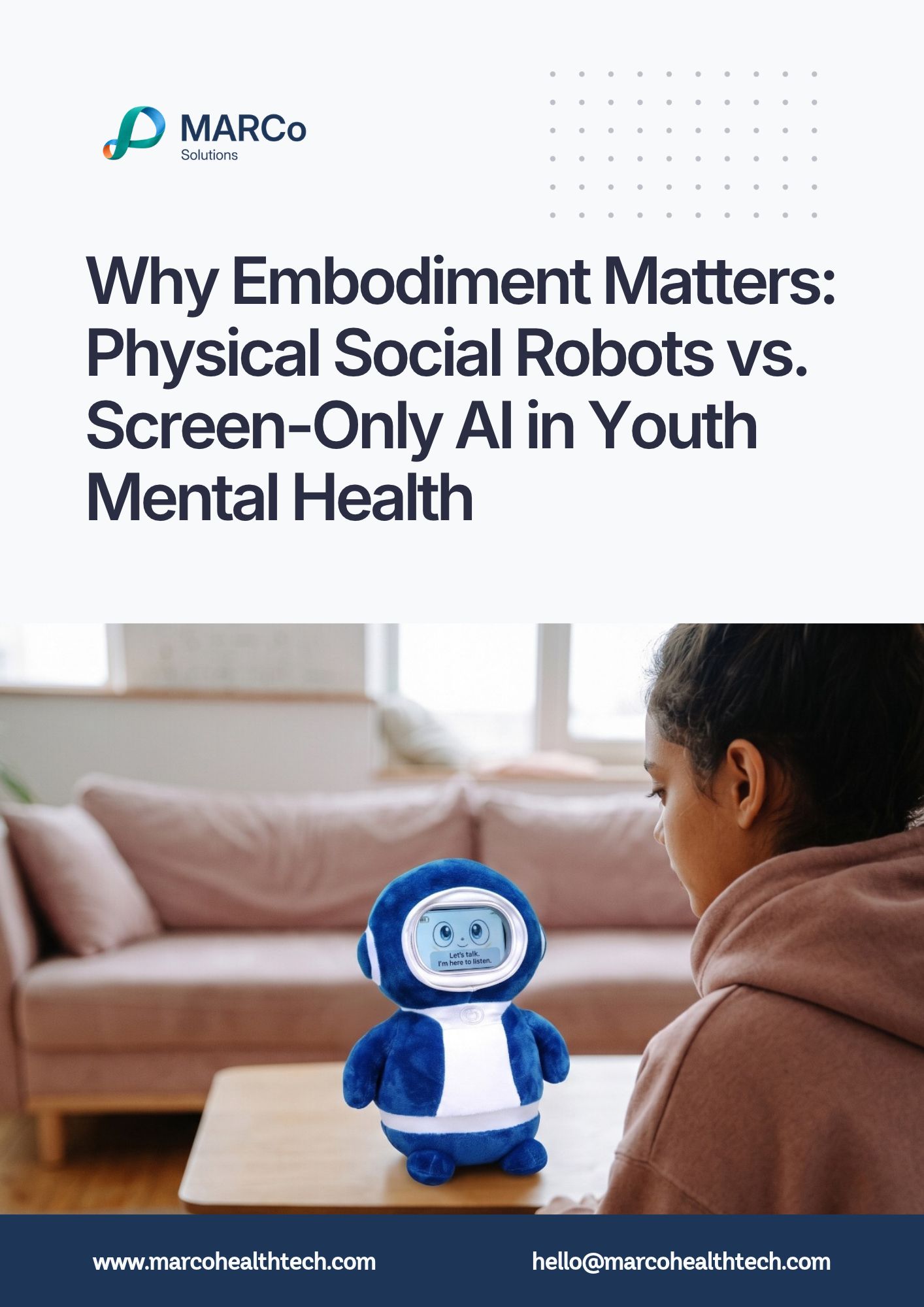
Embodied AI in Youth Mental Health: Why Physical Presence Beats the Screen
Youth mental health needs have outgrown the people available to meet them. In 2025, one in three U.S. high school students reported persistent sadness or hopelessness. Counselor and school psychologist caseloads remain far above recommended levels. Digital tools were supposed to close that gap, but in real-world use the median mental health app keeps fewer than 4% of users after two weeks.
This white paper looks at a different approach: embodied AI, meaning conversational AI built into a physical social robot that shares the student’s space. It pulls together research from pediatric hospitals, education, health coaching and human-robot interaction. Across those fields, physically present robots consistently drew more engagement, more social interaction and more cooperation than the same software running on a screen.
What the paper covers
The youth mental health access gap, using current CDC, SAMHSA and ASCA data
Why screen-only apps and chatbots lose users, even when they’re well designed
The science of social presence, and why young people may disclose more to a non-judging listener
Cross-domain evidence comparing physical robots with tablets, computers and video
MARCo’s internal robot vs. companion app comparison, with its limitations stated plainly
Uses across MTSS tiers: SEL, in-school suspension, attendance, between-session support, screening, and higher education counseling
A governance checklist covering FERPA, COPPA, crisis protocols, and new 2025–26 state laws on AI in mental health
What the evidence does not yet prove, and what a rigorous next study looks like
Why read it
The paper doesn’t overstate its case. Every figure is sourced, the limits of the evidence get their own section, and embodied AI is positioned as support for licensed staff, never a replacement. Decision-makers get a credible, practical basis for evaluating these tools.
Who it’s for
K-12 superintendents, student services directors and MTSS/PBIS coordinators
School counselors, school psychologists, social workers and nurses
University counseling center directors
Clinical directors and clinicians in youth behavioral health
District technology, privacy and compliance leads evaluating AI tools
Get the white paper
Tell us where to send it. We’ll email you a copy right away.